These Are the Scientists Bringing You Safe and Effective Medical Marijuana

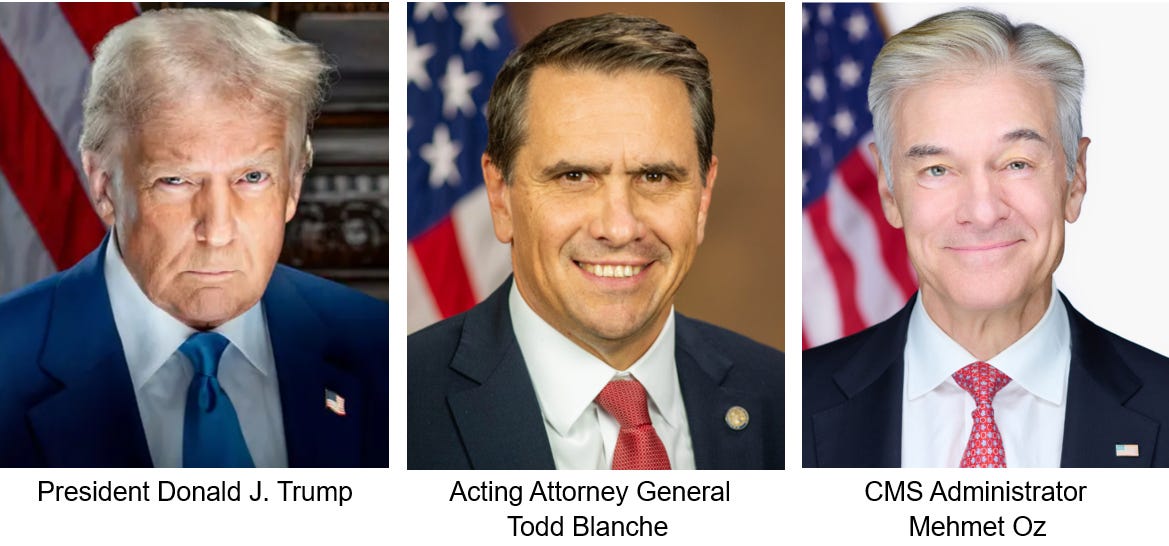
First it was Mehmet Oz, the guru of pseudoscience, who began giving an FDA-unapproved drug—CBD—to Medicare patients . Then it was Todd Blanche who moved another FDA-unapproved drug—this time medical marijuana—into Schedule III. Both acted on Executive Orders signed by President Trump.
In the first sentence of Todd Blanche’s final order, issued last Thursday, he says:
“With the issuance of this final order, the Acting Attorney General of the U.S. Department of Justice places drug products containing marijuana that have been approved by the Food and Drug Administration (FDA) in Schedule III of the Controlled Substances Act (CSA).”
Here’s the problem. The FDA has not approved any drug product that contains marijuana!
FDA has approved Marinol (dronabinol) at low doses and Cesamet (nabilone) at exceedingly low doses. Neither drug contains marijuana. Instead, both were made using pure chemicals. See my Substack from last week.
The Acting Attorney General cites Marinol (dronabinol) and Syndros, but not Cesamet (nabilone). Syndros was taken off the market last year by its manufacturer. FDA approved Marinol in 1985 to treat nausea and vomiting in cancer chemotherapy patients who did not respond to standard medications and in 1992 to treat wasting in HIV/AIDS patients. Cesamet (nabilone) was approved for both uses in 1985.
All three drugs are/were made using pure chemicals, thus eliminating the threat of contaminants. None of these drugs contains marijuana, yet the Acting Attorney General uses the term “FDA-approved drugs containing marijuana” at least 26 times throughout his final order.
In 2018, FDA approved Epidiolex, a drug made from purified CBD. However, the Acting Attorney General makes clear that nothing in his final order applies to hemp products from which purified CBD is made.
He does not understand the scientific term “synthesis.” However, 40 percent of the drugs we use today are synthesized, meaning they are made with pure chemicals to eliminate any chance of contaminants in “natural” products. That’s so you don’t have to chew willow bark (aspirin), for example, to get rid of a headache or fever.
The Acting Attorney General believes synthesis can only be bad, as in synthetic Delta-8 or Delta-10 THC. Ironically, this misunderstanding leads him to say on page 16, last sentence, “Therefore, synthetic THC remains in Schedule I.”
Worse, a medical marijuana license from 40 states will eliminate all requirements of the UN Single Convention and the US Controlled Substances Act, which is based on the Convention, except that dispensaries will have to register with DEA.
In other words, states that legalized medical marijuana will be accountable for strictures specified in the UN Convention and the CSA. The Acting Attorney General says, “[DEA] registrants may rely on state-law labeling, packaging, disposal, and physical security requirements in lieu of the otherwise-applicable federal requirements.”
Based on the strength of a state’s legalization law, doctors can now prescribe an FDA-unapproved drug—medical marijuana—to patients. Prescribing such a drug is considered prescribing an “unapproved new drug,” which is prohibited and carries significant legal and safety risks. So where does that leave doctors? Dentists? Physician Assistants? Nurse Practitioners? Hospitals?
According to the final order, prescriptions must include “the drug name, strength, dosage form, quantity prescribed, and directions for use, among other items.” If you live in a medical marijuana state, does the agency that monitors legal medical marijuana require these safeguards? Heretofore, the medical community was only able to recommend medical pot, not prescribe it, because it is illegal.
To clarify the difference between illegal growers and legitimate growers, Article 23 of the Single Convention on Narcotic Drugs requires that only governments can grow marijuana. Therefore, each medical marijuana company will have to sell its crops to DEA at a nominal fee and DEA will sell the crops back to each company for the same price, plus a fee that will finance the endeavor.
MJBizDaily interviewed several marijuana companies about their reaction to the Acting Attorney General’s final order. Some are seeking partnerships for clinical studies. We have learned from the tobacco and alcohol industries how successful that gambit is.
Others are developing strategies to scale their operations. Here’s what George Archos, CEO of the Chicago-based multi-state operator Verano Holding Corporation, told MJBizDaily. “Completing the historic rescheduling of cannabis to Schedule [III] promises to unlock the full medical, research, and commercial potential of this miracle plant and support the growth and normalization of America’s next great industry in the United States.”